Crosscheck
Paris, November 2026
The smallest unit of truth is a fact.We check them one at a time, in the open, with everyone.
How far can you trust each fact in the news? Crosscheck takes a story apart into its claims and shows you, with the reasons and the evidence. Not true or false: how sure, and why.
Sound on
The problem
Misinformation is nothing new. Misinformation at scale is.
AI
Cheap to make. One false claim, rewritten in as many versions as anyone wants, in seconds.
Social media
Instant to spread. Every version reaches everyone at once, before anyone checks.
$15bn
off Eli Lilly’s market value in a day, after one fake post: “insulin is free now.” The account cost $8.
54%
get their news from social media every week
62%
worry they can't tell real from fake online
37%
trust the news, a ten-year low
Reuters Institute, Digital News Report 2026. Eli Lilly, November 2022: the shares fell 4.4% the next day.
Why nobody catches it
The best lies come as a sandwich.
How I opened the pitch: by introducing myself twice. If you don’t already know , you’ll catch one lie and miss the other.
A lie you catch
“I’m Naman Kapoor. I’m a 64-year-old woman from Texas.”
Nothing true around it to hide behind.
A lie you swallow
Three true facts carried one false one. I’m from India.
Two kinds of false
By mistake or on purpose, it spreads the same way.
Misinformation
False or overstated, shared in good faith.
- 1Lilly’s shares fell 4.4% the next day.
- 2Lilly’s stock plunged after the tweet.
- 3The tweet cost Eli Lilly billions.
- 4Twitter shaves $15bn off Eli Lilly.
Each retelling a little bigger than the last. Nobody lied; the doubt fell away.
Disinformation
False on purpose.
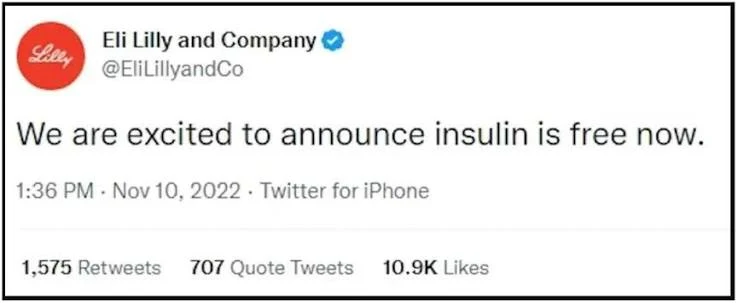 Impostor
The tick was bought for $8. The real account is @LillyPad.
Crosscheck handles both alike: it doesn’t need to know anyone’s intent, only how well each claim holds up. Together they are the top short-term global risk in the World Economic Forum’s Global Risks Report, in 2024 and again in 2025.
Try it
One story, taken apart.
The Eli Lilly story as it was shared, crosschecked. The scores are illustrative.
A story as it was shared · November 2022
Illustrative scores
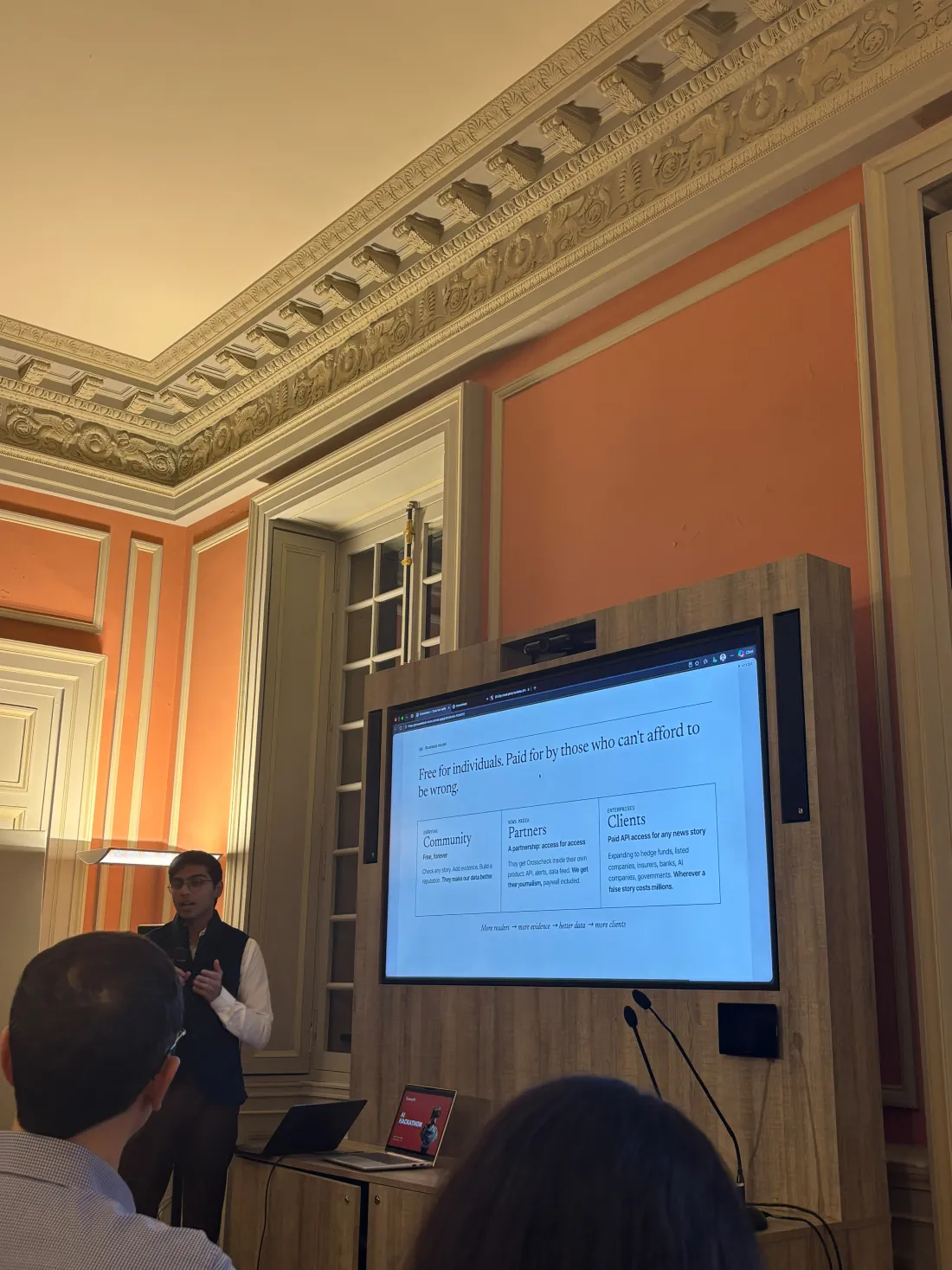
Read whole, it sounds like one story. It is three claims.
Our insight
Repetition is not confirmation.
Every claim is traced back to where it first appeared. Copies count once; only independent sources and evidence raise a score.
98%
30 articles on one story repeat the same claim. If repetition counted, you would be 98% sure.
A real claim from a real story, scored by our prototype on the day.
How it works
Machines first, then people.
Machines can scan the internet. Only people can say what they saw.
Layer 1 · The Scan
Machines, on every article
Engine 1
The Messenger
Who is speaking?
Engine 2
The Message
How is it said?
Engine 3
The Multiplier
How is it spreading?
Layer 2 · The Community
People, with evidence
Evidence
documents, footage, records
Bridging
people who usually disagree must agree
Reputation
earned, and lost
Vouching
you answer for who you trust
Every claim, with a confidence score and the reasons
94%
65%
15%
Trust, but verify.
The team
Five of us, one weekend.
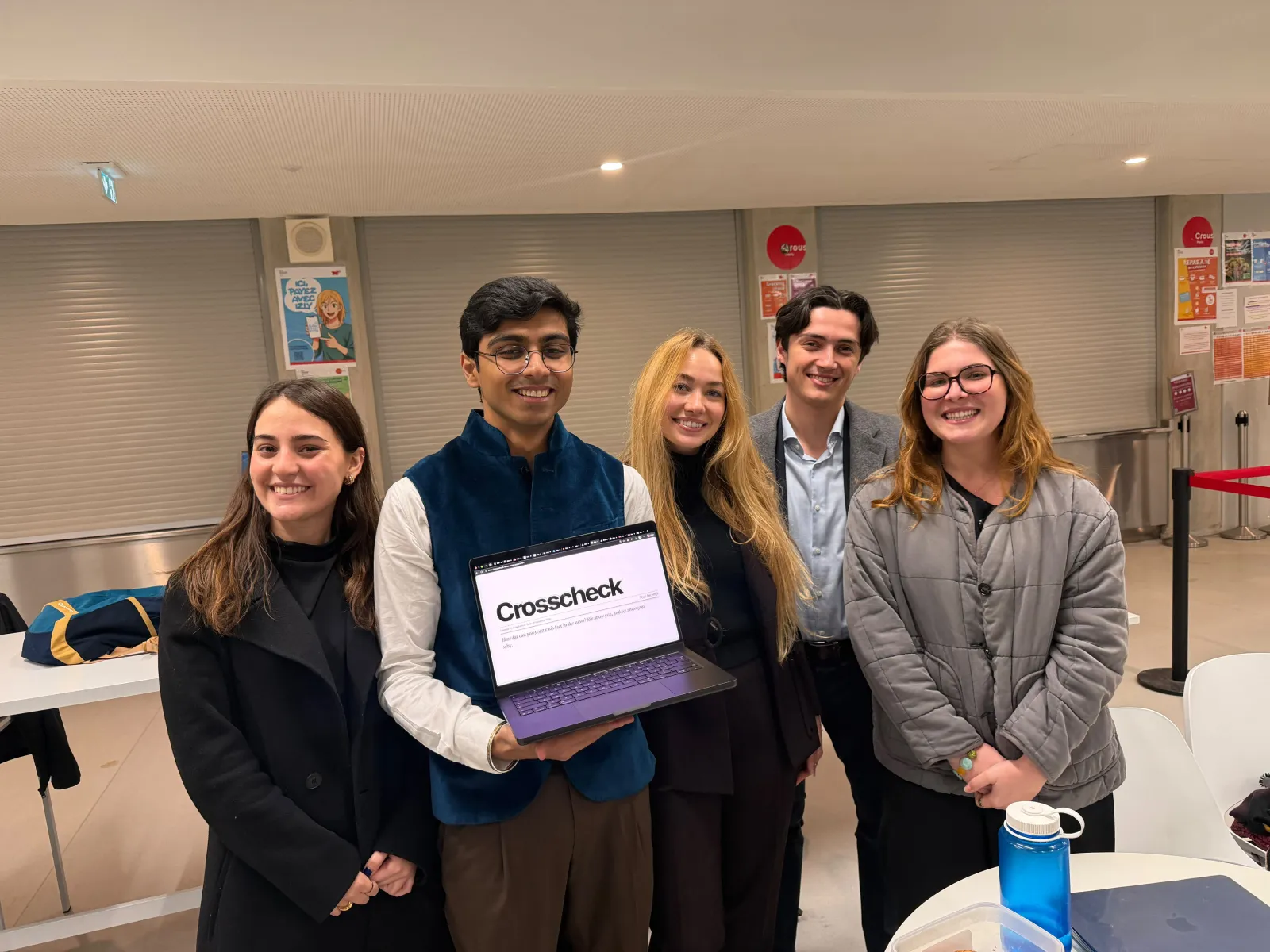
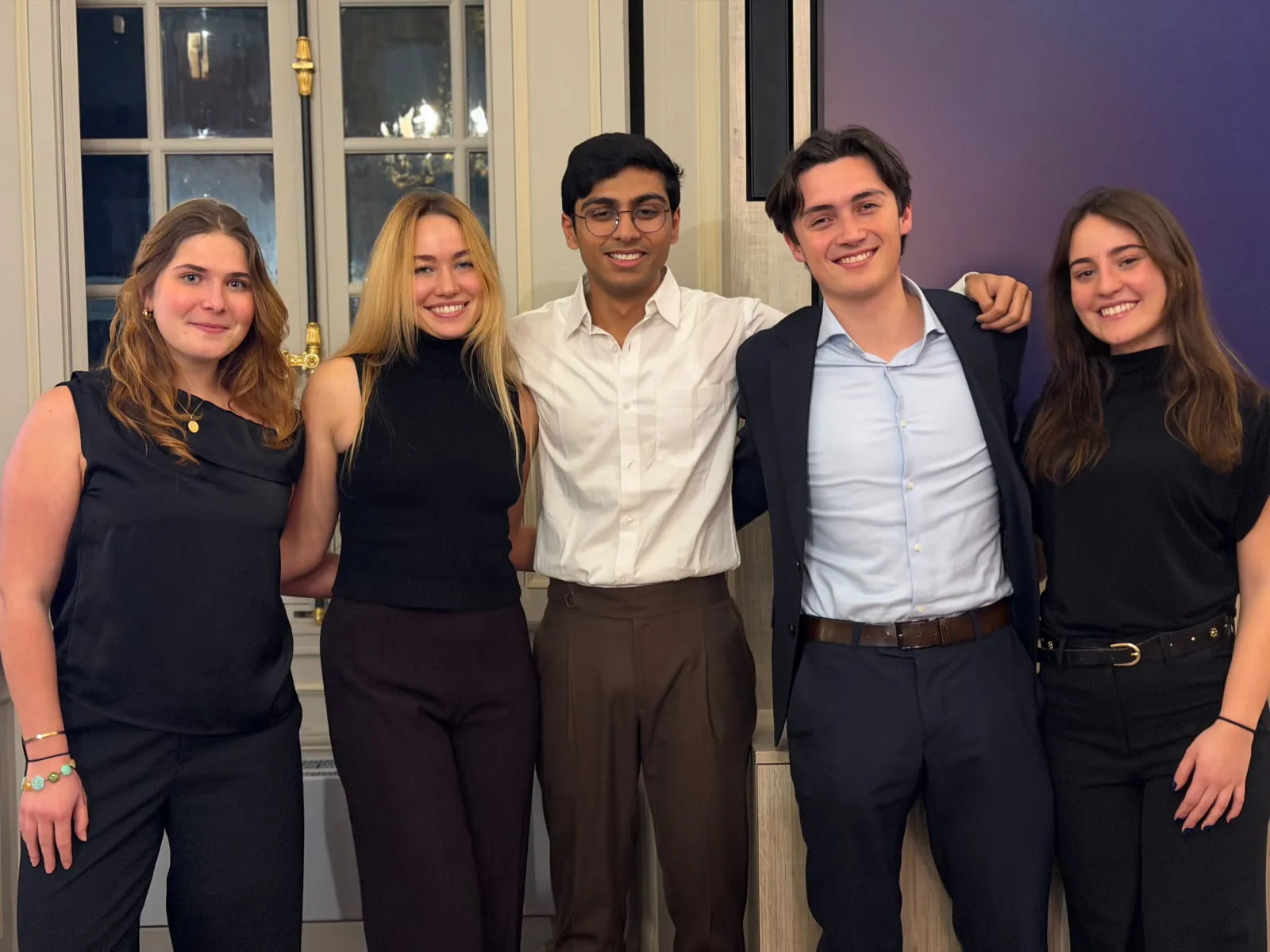
Dana Fidawy, Katherine Mansfield, Jeanne Defaccio, Linn Leon Junge and me. In February 2027 we represent Sciences Po as one of the four finalists of the Transatlantic AI Entrepreneurship Challenge in Cannes.
Thank you to the Sciences Po Centre for Entrepreneurship, the Impact Studio and Prometheus for running the hackathon, and to Accenture, Anthropic, Lovable, FlexUp and Meetable for supporting it.